
Making Cross-Border E-Commerce Work for SMEs:
The 28th Regime and the Future of SME Growth in Europe
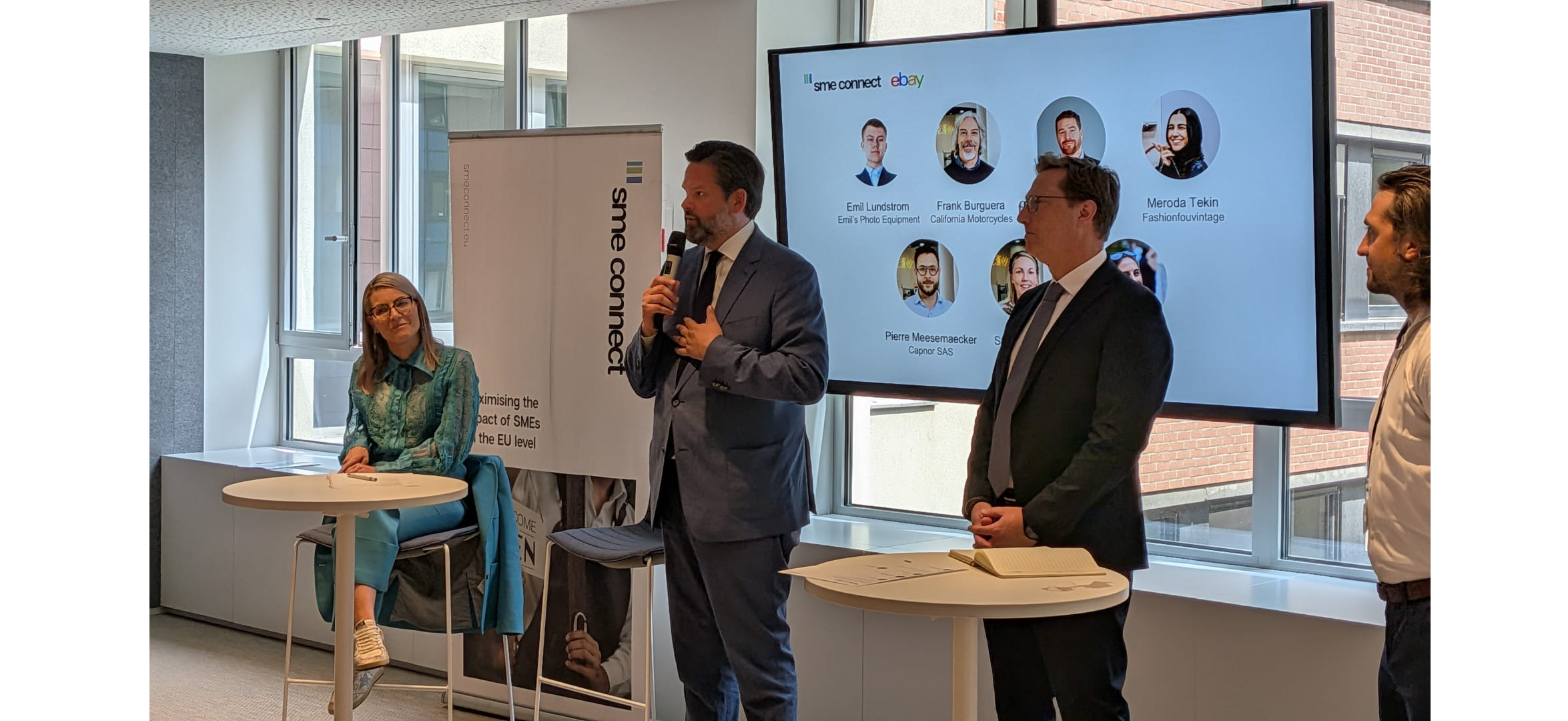
On 23 June 2026, SME Connect, in partnership with eBay, organised a Working Lunch titled “Making Cross-Border E-Commerce Work for SMEs: The 28th Regime and the Future of SME Growth in Europe” at the European Parliament in Brussels. Hosted by Lukas Mandl MEP, the event brought together Members of the European Parliament, business organisations, digital platforms, SME representatives and entrepreneurs from across Europe to discuss how cross-border e-commerce can become a real driver of SME growth in the Single Market.
The discussion focused on one central question: why is it still so difficult for many European SMEs to sell across the European Union, despite the existence of the Single Market? Participants addressed regulatory fragmentation, compliance costs, divergent national implementation, digital public services, the proposed 28th Regime, and the practical role of e-commerce in helping SMEs reach customers beyond their local and national markets.
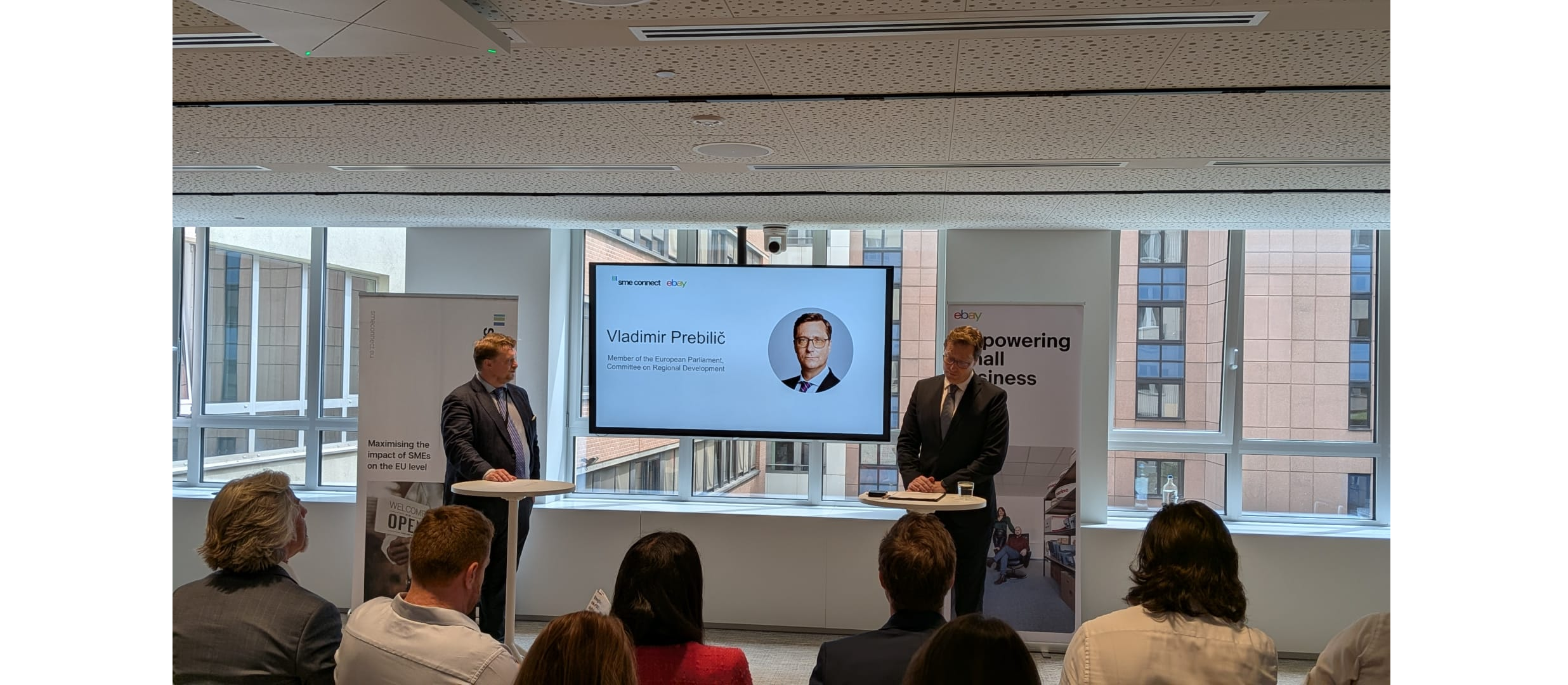
Vladimir Prebilič MEP, Member of the Committee on Regional Development (REGI), opened the discussion by underlining the importance of direct dialogue between policymakers and businesses. He stressed that legislation must reflect the realities faced by SMEs, not only abstract policy objectives. SMEs, he noted, are central to Europe’s economy, employment and regional development. In countries such as Slovenia, their role is even more decisive for economic output and social cohesion.
He strongly supported the idea of the 28th Regime as a way to reduce legal complexity and make cross-border business easier. Fragmented national rules, he argued, discourage SMEs from expanding beyond their home markets and weaken the Single Market in practice. Linking the discussion to regional development, he also pointed to the role of cohesion policy in keeping economic activity alive outside major cities. Strong regions, functioning infrastructure and viable local businesses are not secondary issues, but part of Europe’s long-term stability and competitiveness. As he put it, Europe’s strength is not only about “tanks and cannons and planes”, but also about “strong regions and happy people living in them.”
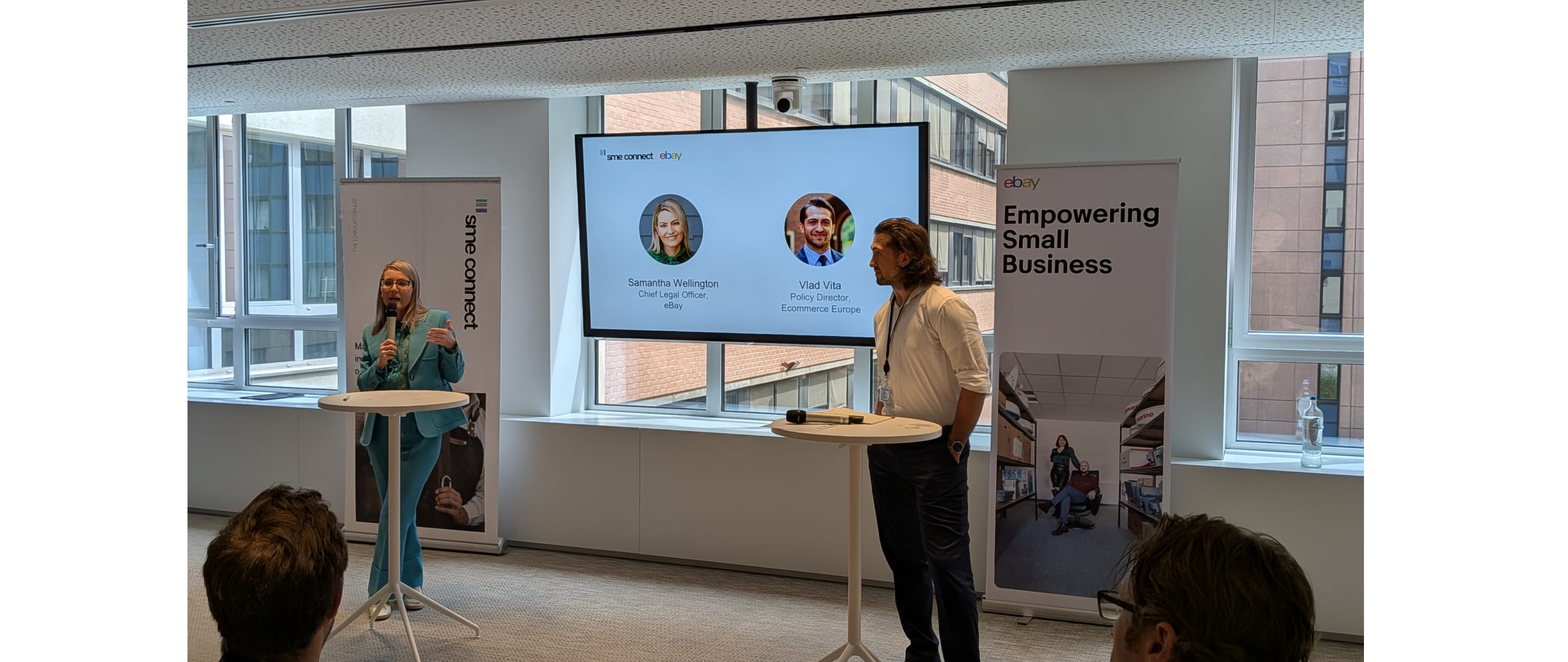
Samantha Wellington, Chief Legal Officer at eBay, placed SMEs at the centre of Europe’s digital and economic transformation. Presenting eBay’s SME Policy Brief, she emphasised that small businesses are not a marginal part of the European economy, but its foundation. Across Europe, 99.8% of businesses are SMEs, and millions of jobs depend on their capacity to grow, trade and adapt.
Her message was direct: Europe has enormous economic potential, but regulatory complexity often prevents SMEs from scaling inside the Single Market. For many small businesses, the challenge is not whether they want to participate in the Single Market, but how they can manage the rules, registrations, reporting duties and compliance obligations attached to it.
Wellington highlighted the striking paradox that, for some SMEs, exporting outside the European Union can be easier than selling to another EU Member State. She therefore called for the 28th Regime to be genuinely useful for SMEs, reducing complexity rather than creating another additional layer of regulation. She also stressed that “Think Small First” must become more than a slogan. Every new rule should be tested against the practical reality of a small business with limited staff, limited time and limited legal capacity. Strong consumer protection, sustainability and trust remain essential, but rules only work if businesses can realistically comply with them. Otherwise, regulation does not necessarily create better outcomes; it may simply push innovation and growth outside Europe.
Vlad-Florin Vita, Policy Director at Ecommerce Europe, welcomed the Commission’s proposal for the 28th Regime and argued that it reflects an important awareness of the obstacles businesses face when trying to scale across borders. He highlighted three principles that should guide future EU action: “Think Small First”, a better understanding of companies’ operational realities, and the highest possible level of harmonisation.
He noted that the 28th Regime can be a valuable step forward if it provides a simple, flexible and coherent framework. However, he also warned that company law alone will not solve the problem. SMEs continue to face fragmentation in consumer law, taxation, environmental regulation, reimbursement rules and product-related obligations. Diverging national rules on legal warranties, for example, still force businesses to adapt to different requirements depending on the Member State in which they sell.
Vita also highlighted the importance of digital public services and the European Business Wallet. These tools can only help SMEs if public administrations are able to implement them effectively. Slow, fragmented or paper-based bureaucracy would undermine the promise of digital simplification. He therefore stressed that Member States must be willing to adapt, harmonise and cooperate more effectively. Without that commitment, even good EU proposals risk remaining too slow or too limited in practice.
The discussion also brought in a strong Single Market perspective from Marion Walsmann MEP, Member of the Committee on the Internal Market and Consumer Protection (IMCO). She underlined that Europe’s 23 million SMEs depend on a functioning Single Market that turns 27 national markets into one European home market. In this context, she stressed the importance of the proposed 28th Regime as a practical step towards greater harmonisation and easier cross-border growth. She also highlighted the European Business Wallet as a key enabling tool, arguing that the 28th Regime will only work effectively if companies can interact directly and digitally with public authorities across Member States. At the same time, she warned that not all national authorities are sufficiently aligned with this objective.
The most important part of the Working Lunch was the Practice Exchange Lab, where SME owners from Italy, France, Finland, Spain and Ireland shared first-hand experiences from their daily business operations. Their contributions gave the policy debate a concrete and practical dimension. They showed that the problem is not theoretical: regulatory fragmentation has direct consequences for growth, investment, employment and competitiveness.
An Italian entrepreneur, Zaira Zanghi, Sales and Account Manager at PC Dynamics, active in refurbished servers, AI equipment and professional workstations described the situation as a “big struggle”. Her message was clear: small companies do not have the money, time or legal teams to adapt to a different set of rules in every Member State. She referred to packaging rules, tax obligations, national registrations and the need for local representatives or accountants as examples of requirements that become extremely costly for SMEs. She stressed that businesses like hers are trying to keep value, jobs and economic activity inside Europe, but are often held back by rules that larger companies can manage far more easily. Her strongest example captured the core problem of the event: it can be easier to sell a refurbished server to the United States than to another EU Member State.
A Spanish entrepreneur, Francisco Burguera, General Manager of California Motorcycles, selling motorcycle parts and accessories worldwide confirmed the same experience. From a small regional business, he sells internationally, but still faces greater complexity within the European Union than outside it. He called for a genuinely harmonised digital market and argued that SMEs need a fair chance to compete with larger companies. His intervention also made a broader competitiveness point: if Europe invests significant effort in controlling external competition, it should also invest the same effort in making European SMEs more competitive at home.
A French entrepreneur, Pierre Meesemaecker from CAPNOR and a Finnish entrepreneur, Satu Kurkilahti, from EQT-Solutions Ltd, both active in refurbishment and reuse, raised a related but distinct concern: much of the current regulatory framework is designed around new products, not products that are reused, repaired or refurbished. This creates legal uncertainty and practical burdens for circular economy businesses.
The French founder explained that many products handled by refurbishing businesses may be around 20 years old, while new regulatory tools such as product passports are primarily designed for future products. As a result, businesses working with older products can be left in a grey zone for many years, without clear guidance on how reused or refurbished parts should be treated.
The Finnish entrepreneur, Satu Kurkilahti, Director of Sales and Business Development at EQT-Solutions Ltd, whose company works with pre-owned measurement equipment from laboratories and research facilities, made a similar point from another sectoral perspective. Many of these products already exist, have already consumed materials and resources, and can remain useful for many years. Reuse therefore makes both economic and environmental sense. Yet regulation often focuses either on new products or on recycling, while the long middle phase of reuse remains insufficiently recognised.
Together, their contributions showed that circular economy businesses do not only need recycling rules. They need a regulatory framework that properly recognises reuse, refurbishment and long product life cycles.
An Irish entrepreneur, Ian Naughton, Owner of the Naughtons Car Dismantlers, selling used car parts online added a further layer to the discussion by describing the broader burden of running and scaling a small business. He referred to tax pressure, staffing costs, administrative complexity, environmental obligations and the difficulty of growing a business in a regional setting. His contribution showed that cross-border e-commerce is not an isolated issue. It is connected to the wider question of whether Europe still makes it attractive to start, grow and sustain an SME. He also suggested that policy should do more to incentivise reuse, including through tax treatment that reflects the environmental value of refurbished and reused goods.
The SME voices gave the event its strongest message: Europe’s problem is not a lack of entrepreneurial ambition. The entrepreneurs present were already innovative, export-oriented and active in sustainable business models. The problem is that the regulatory and administrative environment often makes their growth unnecessarily difficult. They do not ask for lower standards, but for rules that are proportionate, coherent and possible to manage without the resources of a large corporation.
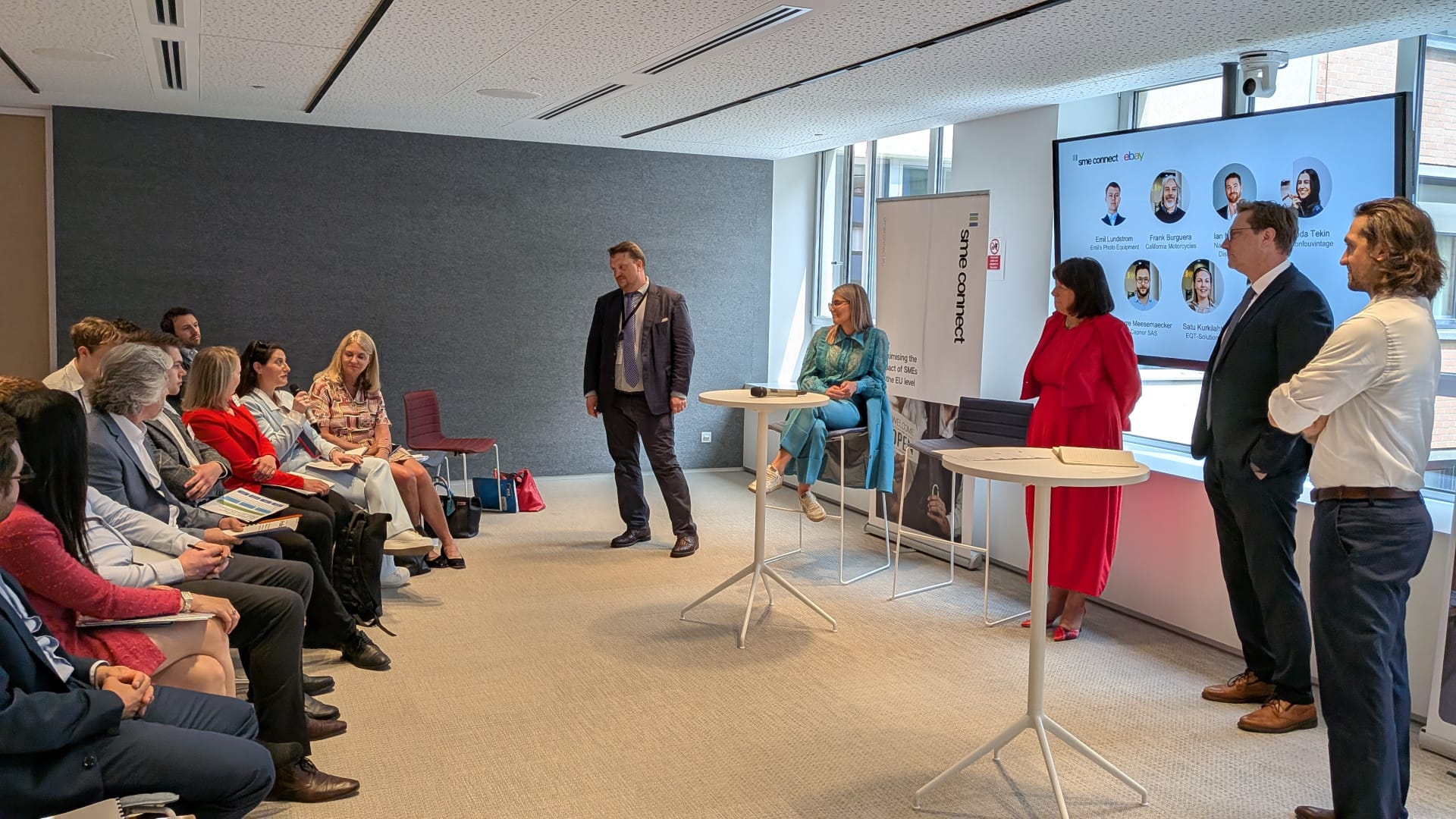
Lukas Mandl MEP, Member of the Committee on Legal Affairs (JURI), responded by stressing that future European legislation should support businesses instead of unintentionally weakening them. Referring to the EU’s “Do No Significant Harm” principle, he argued that policymakers should also apply a “Do No Significant Harm for businesses” approach. Entrepreneurs create jobs, pay taxes, generate prosperity and strengthen Europe’s competitiveness. Their practical realities must therefore be considered when new laws are designed.
Mandl warned that SMEs risk being overlooked in large policy debates around digitalisation, sustainability and global competition. Europe must make it easier both to start and to grow a business. This requires more harmonised rules, less bureaucracy and a stronger competitiveness mindset. He also underlined the importance of platforms and SME organisations in bringing real business experience into the Brussels policy debate.
The discussion also showed that digital platforms can play a practical role in helping SMEs manage compliance, provided the regulatory framework allows them to do so. Samantha Wellington explained that eBay would be willing to use its scale to help small businesses with registration, reporting and filing obligations, particularly in areas such as Extended Producer Responsibility. However, such support requires legislation that permits practical marketplace-based solutions. This point opened a constructive perspective: large platforms and small businesses do not always have opposing interests. In certain areas, platforms can help reduce administrative burdens for SMEs if policymakers create workable rules.
Horst Heitz, Chair of the Steering Committee at SME Connect, linked individual business experiences to the wider legislative debate and stressed that policymakers need real examples, not only general complaints, to understand how rules affect SMEs in practice. He also highlighted the paradox repeatedly raised by entrepreneurs: in some cases, trading with markets outside the European Union is less complex than selling within the Single Market itself.
Heitz summarized that simplification must address both future and existing legislation. A “one-in, one-out” logic or a focus only on upcoming rules will not be enough if the accumulated regulatory burden remains in place. SMEs need a real change in direction: fewer unnecessary layers, clearer implementation, less gold-plating by Member States and a better understanding of how regulation affects small businesses before they have the size and resources to absorb compliance costs.
The Working Lunch demonstrated broad agreement that Europe’s SMEs need a simpler, more harmonised and more practical regulatory environment. The proposed 28th Regime was widely seen as a positive opportunity, especially when combined with digital tools such as the European Business Wallet, but only if it delivers genuine simplification and does not become another complex legal framework.
Participants agreed that “Think Small First” must be applied seriously, including to consumer protection, environmental rules, taxation, digital public services and implementation by Member States.
The event also made clear that cross-border e-commerce is not only a digital policy issue. It is linked to regional development, circular economy, entrepreneurship, competitiveness, administrative capacity and Europe’s ability to create scale inside its own market. SMEs can reach customers across borders, revitalise regional economies and support sustainable business models, but only if the Single Market works for them in practice.
By bringing together policymakers, platforms, SME organisations and entrepreneurs, the Working Lunch provided a practical contribution to the debate on the future of SME growth in Europe. Above all, it showed that the voice of SMEs must not be added at the end of the policy process. It must be part of the process from the beginning. The entrepreneurs’ message was consistent and clear: Europe has the talent, products and ambition. What SMEs need now is a Single Market that is simpler to use, easier to navigate and better aligned with the reality of doing business.