
EU–China Relations for SMEs:
A Strategic Discussion
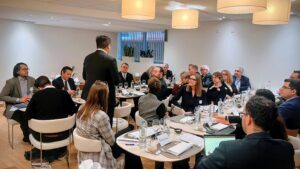
A strategic working lunch on EU–China economic relations has initiated a new dialogue tailored specifically to small and medium-sized enterprises, SMEs. The meeting was hosted and convened by PAUL RÜBIG, member of the European Economic and Social Committee and member of the EESC EU–China Round Table, who welcomed participants together with Prof. MILENA ANGELOVA, member of the EESC Employers’ Group and Secretary General of the Bulgarian Industrial Capital Association. From the outset, the exchange unfolded as a lively and open debate, with all participants contributing their institutional, economic, and practical perspectives.
Chaired by Rübig, the group brought together a circle reflecting the impact of EU–China relations on SMEs from both practical and institutional angles. It included ANGELIKA WINZIG MEP, and LUKAS MANDL MEP, accompanied by MARKUS PIEPER, advisor to the EESC and former MEP, and joined by stakeholders covering the key layers shaping EU–China business ties for SMEs. These included institutional and policy actors from Brussels, specialised EU bodies and agencies with sector-specific expertise—particularly on intellectual property—China-based SME support structures, national chambers and business organisations from member states, European sector and digital-trade associations, and a mix of company representatives and entrepreneurs with direct China experience, ranging from industrial value chains to a major e-commerce platform perspective. The range of contributions therefore ran from classical manufacturing and supply-chain cooperation to digitally driven export models and platform-enabled market access.
The round table was conceived as the opening step of a broader working process for 2026. Its purpose is to organise the exchange and turn it into practical, politically viable demands and solution pathways for European SMEs. The approach is deliberately two-fold, urging Europe to engage the opportunities offered by the Chinese market with pragmatism while remaining fully aware of security risks, strategic dependencies and enduring imbalances in market access and competition.
The discussion began with a sober assessment of the overall setting. EU–China economic relations now operate in an environment marked by systemic rivalry, heightened security risks, and sensitive strategic dependencies, particularly in raw materials, intermediate goods, and key technologies. For European SMEs, these factors no longer sit on a geopolitical “overlay”; they directly shape location choices, supply-chain strategy, and investment decisions. Winzig, Mandl, and Pieper framed this politically with an eye on potential escalation and worst-case scenarios: Europe must be prepared for all relevant contingencies, reduce vulnerabilities where they become strategically risky, and at the same time pursue the economic opportunities of the relationship pragmatically, with a clear-eyed view of market realities, competition, and security.
This was followed by a practical market-entry perspective. LIAM ZIQI JIA, team leader at the EU SME Centre in Beijing, outlined how European SMEs actually enter the Chinese market and which entry models have proven workable on the ground. The emphasis was on realistic, step-by-step approaches, favouring a structured entry supported by reliable guidance and clear risk buffers rather than a single decisive leap. Against this backdrop, participants also pointed to persistent obstacles — notably a lack of reciprocity in market access and tenders, as well as competitive and pricing pressure in segments shaped by overcapacity and asymmetric support structures.
A concrete European reference point came from SEBASTIAN KÖBERL, team leader for the EU Representation of the Austrian Federal Economic Chamber, WKÖ. Using the development of trade and economic figures between China and Austria as an example, he highlighted a pattern relevant to many member states: a structurally imbalanced trade relationship where Europe needs to apply leverage, through stronger reciprocity, improved market access, and enforceable conditions for fair competition for SMEs.
On the operational level, the discussion focused on hurdles that hit SMEs especially hard in China engagement. The protection of intellectual property emerged as a persistent core issue that often determines costs and feasibility for smaller firms. MARCO GASPARRONI, board member of the EU Project Innovation Centre, EUPIC, and ARŪNAS ŽELVY and CEZARA PETRUC, liaison officers at the European Union Intellectual Property Office, EUIPO, placed this in the China context and underlined that neither analogue nor digital market entry is sustainable without early protection and credible enforcement options.
The exchange also brought into focus the strong heterogeneity across sectors. BART VAN ZWOL, CEO of WHC Labs, THOMAS HOOPS, general manager of NHU Europe GmbH, and ECKHARD BAUSS, founder of NHU Europe, contributed hands-on entrepreneurial experience from different value chains, ranging from industrial supply chains and production cooperation to more digitalised business models. PAULINE BASTIDON, director for Trade and Economic Affairs at spiritsEUROPE, stressed from the perspective of a European sector association that China remains structurally relevant for many industries; for a substantial part of SMEs, the market is neither replaceable nor easily avoidable in the short term. What emerged was a wide spectrum of China profiles, from areas with demanding access and competition conditions to sectors where European specialisation, quality, and reliability meet stable demand and where cooperation can be commercially sound. The practical task for 2026 is therefore to make opportunities systematically usable and improve the conditions that allow positive business models to scale, while keeping risks manageable where they are real.
Special attention was devoted to the digital route. E-commerce was described as a low-threshold, pragmatic entry path: it enables market testing with limited upfront investment, scales reach quickly, and postpones physical presence until reliable demand signals exist. China offers a highly developed digital ecosystem, and for European quality, niche, and sustainable products, tangible growth pathways are visible. ERIC PELLETIER, vice president and head of International Government Affairs at Alibaba Group, outlined the platform reality: in practice, European SMEs entering digitally rely largely on the major Chinese ecosystems, predominantly Alibaba, especially Tmall and Taobao, because reach, payment, and logistics infrastructure are bundled there. This concentration enables scale but also creates dependencies and raises the bar for IP protection, compliance, and data and product security even before an online launch. Pelletier also referred to a recent study with robust market data whose implications should be examined more closely in the 2026 workstream. The takeaway from the round was clear: SMEs need a straightforward, accessible “digital entry path” for China, combining platform know-how with IP toolboxes, compliance guidance, and reliable logistics and payment setups, supported by experienced, China-based assistance structures. A further practical observation pointed back to the European single market. For some SMEs, selling online to China can now be easier than selling between EU member states. Fragmented standards, labelling, and procedures inside the single market were identified as a self-inflicted competitiveness barrier that must be addressed in parallel to any China strategy.
The working lunch therefore outlines a concise and operational agenda for 2026, focusing on sector-specific de-risking grounded in clear risk maps and concrete action options for SMEs; improved preparedness for adverse scenarios, supported by early-warning mechanisms suited to smaller firms; measurable progress on reciprocity in market access; a reduction in single-market fragmentation to restore competitiveness; and the development of a practical digital-entry route to China that brings together platform expertise, logistics, payment solutions and IP safeguards, enabling e-commerce to serve as a realistic testing and scaling channel. The programme also foresees a curated portfolio of success cases and sector-specific best practices, ranging from traditional industrial cooperation to digital export models, so that workable examples can be translated into replicable growth pathways for SMEs.
Taken together, these elements mark the beginning of a sustained SME-focused dialogue on China within the EU–China Round Table. The direction is balanced but firmly stated, encouraging Europe to seize opportunities without naïveté and to manage risks without disengagement. The 2026 process aims to produce a practical and implementable framework that facilitates market access for European SMEs, strengthens fairness, and reduces strategic vulnerabilities, enabling smaller firms to grow where genuine demand exists.