Making Digital Product Passports Work for Small Businesses

On the 4th of November 2026, SME Connect, in partnership with Amazon, organised a working breakfast titled “Making Digital Product Passports Work for Small Businesses” at the European Parliament in Brussels. Hosted by Maria Grapini MEP, the event explored how Digital Product Passports (DPPs) can simplify product compliance and facilitate access to the EU Single Market, while ensuring that implementation costs and requirements remain manageable for smaller businesses.
The discussion focused on a central question: how can DPPs deliver practical benefits without creating additional administrative burdens? Participants broadly welcomed the potential of digital product information but stressed that success will depend on proportionate requirements, affordable solutions, clear timelines and an approach that reflects the realities of SMEs, including one-person businesses.
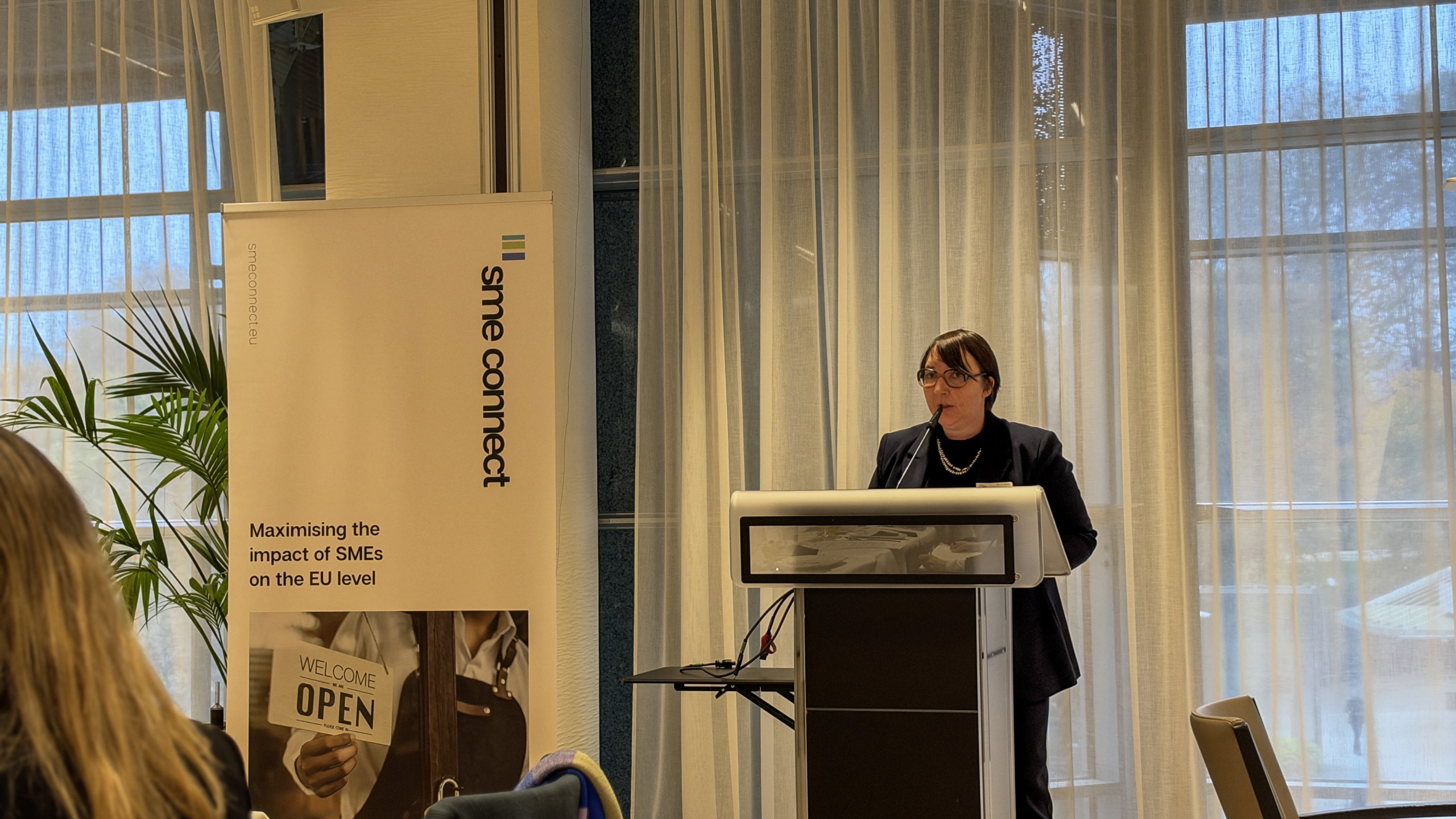
MARIA GRAPINI MEP, Vice-Chair of the Internal Market and Consumer Protection Committee and Board Member of SME Connect, opened the discussion. Drawing on her years as an entrepreneur and as president of a textile industry association in Romania, she set out three conditions for a passport that works: the same rules across the internal market and in cross-border trade, avoiding fragmentation and unnecessary dependence on individual service providers; practical support in the form of affordable tools, clear guidance and training; and transparency that goes hand in hand with the protection of commercially sensitive information, since businesses need confidence in how their data will be used and who can access it. She framed the task as a shared responsibility of the Commission, the Parliament, national authorities and business associations, and insisted that companies be given time to adapt. 60% of Europe’s SMEs, she reminded the room, are one-person companies — and those companies need support.

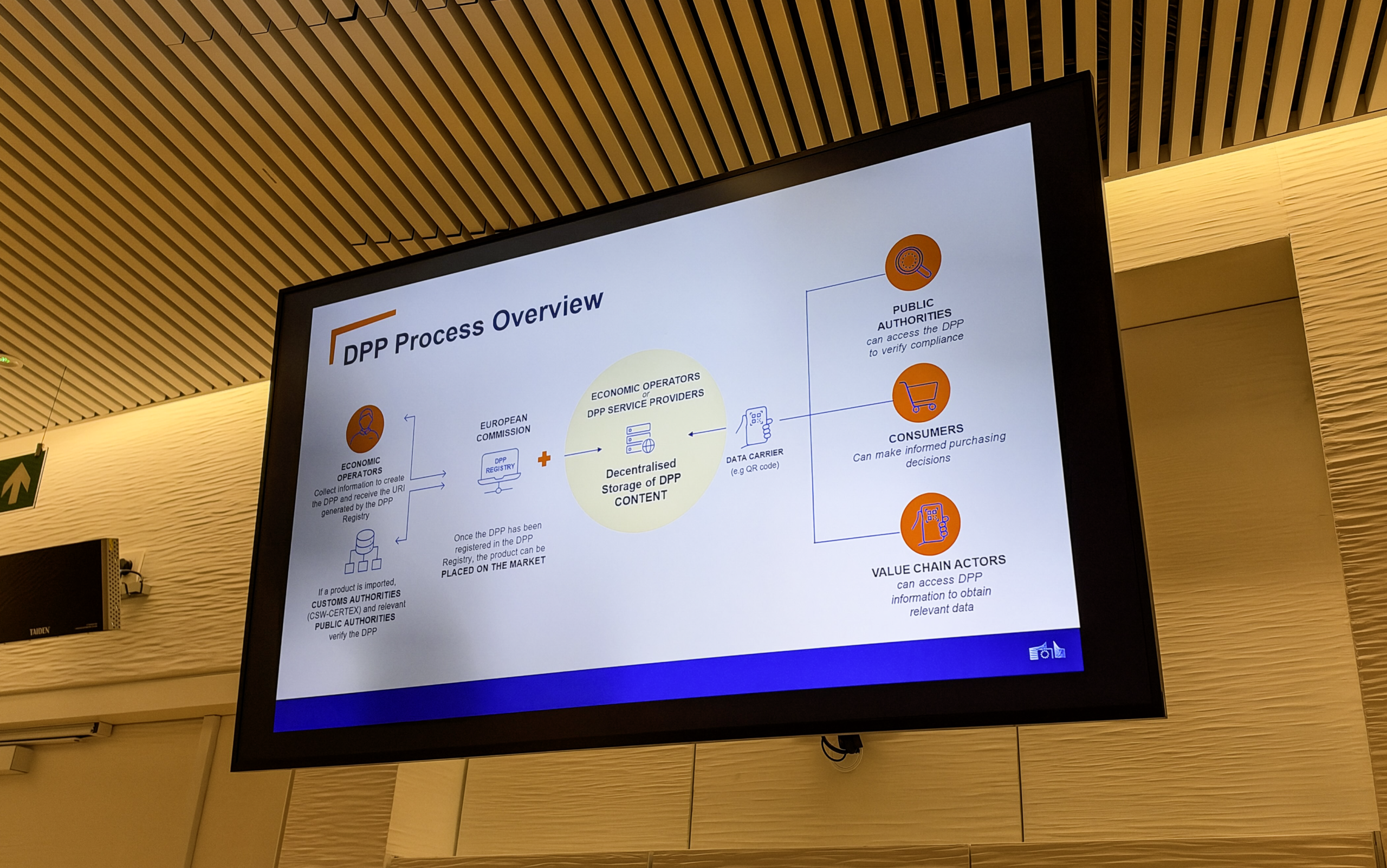
FRANZISKA ZIBOLD, Policy Officer at DG GROW, European Commission, responsible for the standardisation that links the technical system to the legislation, explained what the passport is — and what it is not. The data behind a DPP is stored in a decentralised way, in the hands of economic operators or their service providers. The Commission runs only a light registry: a company identifies itself once, uploads the links to its passports and receives a registration proof in return. The registry holds identifiers, not data, and it will become the entry door to the internal market, with every product eventually registered before it crosses the border or is sold in the EU. Product groups will be phased in, starting with large batteries. The harmonised standards, finalised at CEN-CENELEC and now being published, are technology-neutral and sector-independent: businesses can choose from a whole list of competing solutions, which keeps prices down, and compliance with a harmonised standard requires no certification. A new ISO committee, launched on a German initiative, may make the European standards the basis for a worldwide system.
The passport, she stressed, is a standardised container that can hold any information — a declaration of conformity, a label, an instruction video, an environmental certificate — not only ecodesign data. The forthcoming European Product Act envisages using it first for compliance information, which means moving existing paperwork from paper to digital rather than collecting anything new. For smaller businesses she saw a genuine opportunity, as consumers begin to choose on quality, durability and performance rather than on price alone. The Commission offers sector webinars, video guides and a test environment for the registry, and she issued one practical warning: many providers sell full packages modelled on the battery passport, the most complex case of all. Some products will need just three data points and companies should look at what their own product actually requires.
DAVID JEVONS, Partner at Oxera, presented the firm’s July 2026 assessment of DPP implementation costs — the second of two studies commissioned by Amazon, the first having examined the benefits. His central finding was that the cost lies not in the QR code or the label but in collecting, checking, organising and maintaining the underlying data, often from other businesses in the supply chain. That cost varies enormously: firms with structured product data can build on existing systems, while those running on spreadsheets face far more work; costs rise with larger product ranges, frequent product changes and fragmented supply chains; and smaller firms, with fewer units over which to spread a fixed cost, pay more per unit and lose competitiveness. Perhaps the biggest cost, he argued, is the one that never makes it into any spreadsheet: uncertainty. When businesses do not know what will be required, they overestimate, over-invest, or decide not to enter a market at all.
Using the Commission’s own impact assessment for toys, Oxera estimated a benefit-to-cost ratio of 1.6 — €1.60 of benefit for every euro spent. If recurring costs turn out just 20 per cent higher than assumed, that ratio falls to 1.3; across plausible scenarios it ranges from a marginal 1.1 to a healthy 2. The value for money of the whole policy, in other words, hinges on getting the costs right. His recommendations followed directly: keep requirements proportionate and reserve granular data for higher-risk products; recognise that sectors differ in digital maturity; provide clarity earlier on what is required, at what level and by when; build on interoperable standards that industry already recognises rather than waiting for the perfect one; and review requirements over time, resisting the temptation to add “just one more” data point without weighing its cost.
The policy–practice exchange opened with VALÉRIE BERCKMANS, an independent fashion designer who founded her Brussels label more than twenty years ago and runs it alone. Working with organic and upcycled materials and local production, she highlighted the challenges of managing growing regulatory requirements alongside designing, producing and selling her products. With DPPs, new packaging requirements and green claims rules adding to the workload, she stressed that one-person businesses cannot be expected to meet the same compliance demands as large companies. She called for clear requirements, realistic deadlines and greater responsibility for suppliers in providing product information. She also highlighted the particular challenges facing upcycling businesses producing unique garments, for which standardised data requirements may be difficult to apply.
NIKI DE SCHRYVER, Founder of COSH!, a platform representing more than a thousand micro-businesses across Belgium, the Netherlands, Germany and beyond, spoke both as an advocate for those businesses and as a DPP provider. A self-declared fan of the passport — she helped launch the world’s first fully transparent luxury fashion brand in 2010 — she described a provider market of over a thousand companies, most of them unwilling to take on clients paying less than €7,000 a year, a sum that would simply close many of her members. COSH! has partnered with a provider from the CIRPASS consortium to offer passports from €30 a month, but the economics remain fragile: the team trained to onboard small firms costs more than those firms are willing to pay, and the repeated postponement of the delegated acts means businesses hesitate while technology providers go bankrupt one after another. She added three practical requests: let small brands attach the GOTS certificate of the fabric they buy to the passport, since certifying themselves would cost €5,000 and their sewing workshop another €5,000; exempt upcycling designers from fabric-composition requirements, as the scanner needed to identify a blend costs €3,500; and rethink the durability metric, given that footprint rules assume a dress is worn seventy times while wardrobe studies find the average garment is worn seven. COSH!’s own digital wardrobe, tracking 23,000 real consumers, shows ultra-fast-fashion items worn three times against more than 150 for slow-fashion brands.
JAN-FREDERIK KREMER, Director General of IVSH, the Association of the German Cutlery and Houseware Industry, represents a sector that still makes 80-85% of its products in Europe, is 90% SMEs and is heavily regulated because its products touch food and skin. He compared the DPP to the Junior Ranger passport his son collects stamps in at American national parks — useful only if everyone takes part, and only if someone checks the stamps. His association was among the first to back the passport, and he praised the Commission’s standardisation work as fast, hands-on and SME-friendly. But three things must follow. First, the once-only principle must be made binding: if a declaration of conformity sits in the passport, every actor in the value chain must accept it, instead of a manufacturer receiving twenty or thirty differently coloured templates asking for the same information — over-compliance that comes from the market, not from authorities. Second, sectors should build shared solutions rather than leaving every firm to buy its own; IVSH is developing one with federal co-funding, involving market authorities and test houses. Third, he stressed that DPPs must provide reliable and trustworthy product information to support effective market surveillance and help identify non-compliant or potentially unsafe products. His 2026 bureaucracy monitor found that 86% of member firms consider EU regulation too complex, scoring its practicability at just 2.29 out of 10, even though 97% support the underlying objectives. His ask to the Commission was to use the passport horizontally, to stop each DG inventing its own templates, and to let fast-moving sectors go digital-first.
NATHALIE RUBIN-DELANCHY, Public Policy Manager – EU at Amazon, began with the observation that replacing many requests for the same data with one source serving many users is exactly what the passport should solve. More than 100,000 European SMEs sell on Amazon, many of them small family firms in rural areas, and they generate around 60% of its sales. A 2024 survey of over 2,000 SMEs in 21 countries found fragmented labelling among the top single-market barriers, with 91% saying a digital passport in place of physical labels would help them grow faster; today it takes six to twelve months to relabel a product for a new EU language, information a passport could add overnight, and Oxera’s first study found consumer electronics alone could cut costs by 15% by digitising manuals and conformity documents. Among the companies Amazon surveyed, including non-EU sellers who must also comply, three concerns stood out. 60% will not begin preparing until the data requirements are clear — and she urged a sharper distinction between the system, which is largely defined, and the data, which is not, particularly in textiles. Most have no supply-chain visibility beyond tier one, which is why she proposed allowing good-quality proxies where exact figures cannot be obtained. And a third of sellers said they would leave the EU market if DPP costs proved too high. Her prescription was a phased implementation: get the system in place, digitise what companies already hold, and add sustainability data as it becomes available.

The open discussion raised further questions about the challenges facing small producers, artisans and businesses outside the EU. Participants highlighted the importance of accessible training, protecting commercially sensitive information and ensuring that smaller suppliers can meet requirements without disproportionate costs.
The exchange also explored how DPPs could improve market surveillance by making product information easier to access and verify. At the same time, participants stressed the need to balance transparency with data protection and to ensure that responsibility for collecting information is shared across supply chains.
MICHAEL JÄGER, President of the Taxpayers Association of Europe and Special Advisor at SME Connect, closed the discussion by emphasising that the success of DPPs should be measured by their practical value to businesses. He raised three central questions: what implementation will cost, whether it will genuinely reduce bureaucracy and strengthen competitiveness, and whether it will make cross-border trade easier.
He warned that simply digitalising existing administrative processes would not necessarily reduce bureaucracy. Instead, DPPs should deliver measurable simplification and ensure that the benefits justify the costs. He also encouraged the Commission to reflect the practical concerns raised during the exchange in its impact assessments.
Above all, the exchange highlighted the need to recognise the diversity of European SMEs, from manufacturers with established digital systems to independent designers and one-person businesses. DPPs should make compliance simpler and product information more useful, rather than adding another layer of complexity for the companies they are intended to support.