From EU Digital Strategy to SME Reality: Empowering SMEs to Deliver Europe’s Competitiveness and Digital Capability
On Tuesday, 9 June 2026, SME Connect hosted a high-level Lunch Forum “From EU Digital Strategy to SME Reality: Empowering SMEs to Deliver Europe’s Competitiveness and Digital Capability” at the European Parliament in Brussels. The event was organised in partnership with the Mastercard Center for Inclusive Growth as part of the Mastercard Strive EU Summit.
Hosted by Tomáš Zdechovský MEP, Board Member of SME Connect, and moderated by Josianne Cutajar, Special Adviser on AI at SME Connect and former Member of the European Parliament, the forum brought together policymakers, business associations and SMEs to examine the gap between Europe’s digital ambitions and the operational realities facing small and medium-sized enterprises across the continent. Mastercard Strive EU innovators contributed case studies from their work with micro- and small businesses, grounding the discussion in implementation experience and scalable lessons.
Tomáš ZDECHOVSKÝ MEP opened the forum by framing the political stakes of SME digitalisation at the current legislative juncture. He underlined the importance of inclusive approaches that reach businesses across all member states, and welcomed the presence of entrepreneurs in a parliamentary setting as a signal that Brussels-level discussions need to be anchored in real business experience.
Alexandra KUXOVÁ, Team Leader for SME Policy Coordination and Outreach at DG GROW of the European Commission, presented the Commission’s current policy approach to SME digitalisation, highlighting several concurrent priorities: the simplification omnibuses, which she estimated could generate €4.4 billion in savings for SMEs; the ‘once only’ principle in digital reporting; the Single Market Strategy; and the forthcoming SME ID, a self-assessment certificate designed to streamline access to EU funding and public procurement. She also discussed the EU Inc. proposal (formerly the 28th regime), which aims to allow businesses to incorporate across all 27 member states in 48 hours for minimal cost, and the Scale-Up Strategy. Kuxová noted that only 14% of SMEs currently use AI tools, and that the gap with larger firms is widening. She called for combined action on simplification, financing, and regulatory conditions, including the upcoming European Competitiveness Fund and a dedicated scale-up fund targeting robotics, semiconductors, and clean technology.
Solveig HONORÉ HATTON, Senior Vice President, Public Sector, Mastercard Europe, framed SME competitiveness around three requirements: access to regulatory ‘oxygen’ (reduced complexity), ongoing practice through upskilling in digital and AI tools, and resilience checkpoints to identify vulnerabilities before shocks materialise. She cited data showing that 50% of SMEs experienced a cyberattack in 2025, and that 60% of those affected risk going out of business within six months. She described Mastercard’s Strive EU programme as a deliberate effort to design solutions intentionally for smaller enterprises, noting that the heterogeneity of SMEs requires tailored approaches rather than one-size-fits-all interventions.
Ben BUTTERS, CEO of Eurochambres, agreed that SMEs often fall between the cracks of large industrial policy initiatives. He stressed that the simplification agenda, while politically significant, has not yet translated into a felt reduction in regulatory burden for entrepreneurs on the ground. He identified access to markets, resources, and finance as the three fundamental needs of growing SMEs, and highlighted a recent announcement by finance ministers of six member states to coordinate capital markets supervision as an encouraging development for unlocking citizens’ savings for productive investment.
Leo LARGILLET, CEO and Co-Founder of Online Now! and Ambassador for Digital Engagement – AI at SME Connect, argued that Europe’s difficulties in building competitive digital markets stem less from a lack of shared vision than from a reactive approach to policy, starting from points of disagreement rather than common direction. He described the current moment as a shift in the nature of intelligence itself and called for a forward-looking approach to AI adoption that matches the pace of the transformation underway.
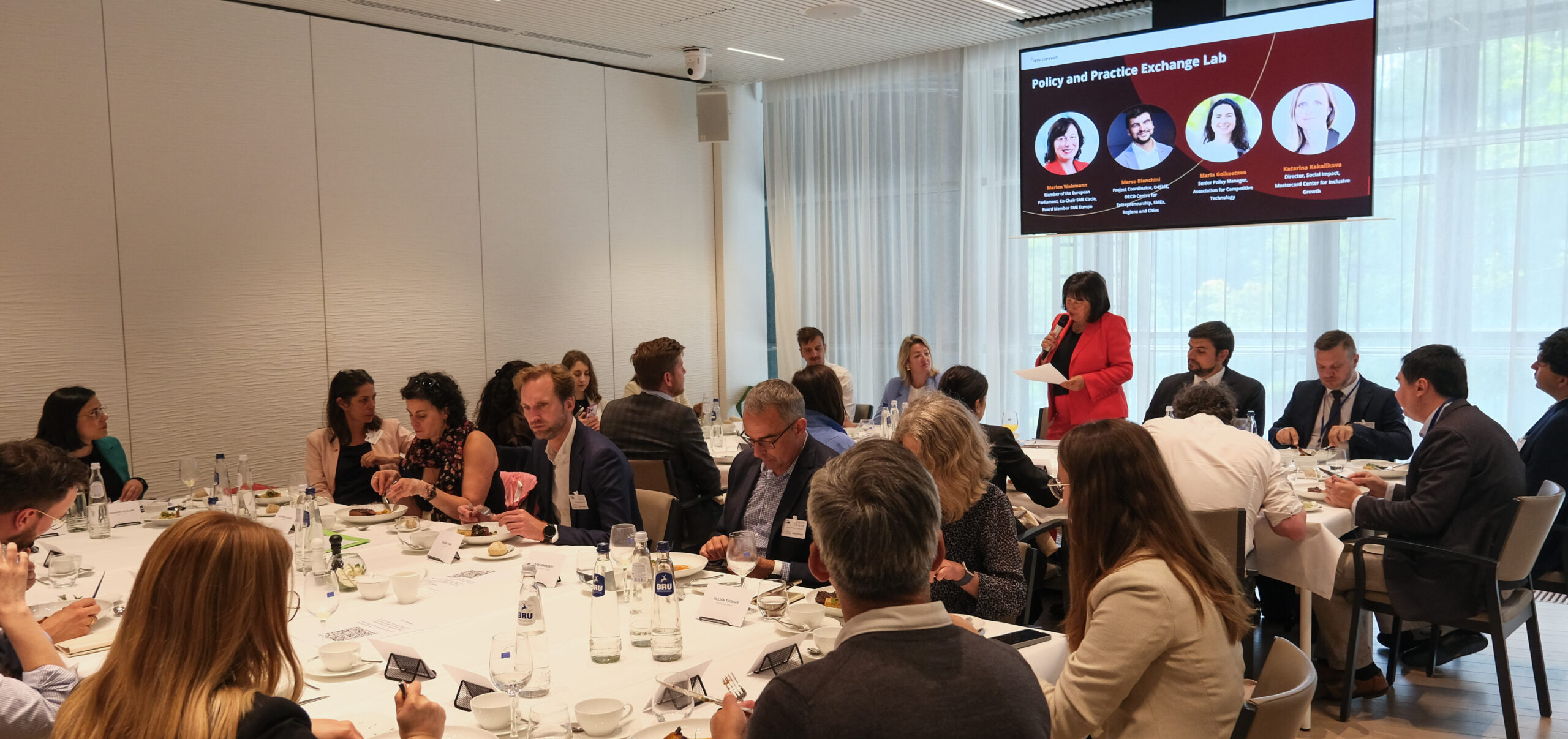
Policy and Practice Exchange Lab
Marion WALSMANN MEP, Co-Chair of the SME Circle and Board Member of SME Europe, identified the European Business Wallet as the single most transformative regulatory change that could be made for SMEs in the near term. She argued that the administrative burden of proving business identity, submitting documents, and complying with different procedures across 27 member states is a genuine barrier to cross-border growth, not merely an inconvenience. As shadow rapporteur for the EPP Group on the file, she said she was pushing for a user-friendly, interoperable solution that would work across all levels of administration and carry real legal recognition, while calling for targeted support to help SMEs set up and benefit from the system.
Marco BIANCHINI, Project Coordinator of D4SME at the OECD Centre for Entrepreneurship, SMEs, Regions and Cities, brought cross-country evidence to the discussion. He noted that AI adoption among businesses has nearly tripled in two years, from 6.6% to close to 18%, though the growth rate is faster for larger firms, widening the gap. He argued that policy needs to move beyond measuring uptake in aggregate and instead identify how businesses are using AI — from basic productivity tools to integrated agents — since the appropriate policy response differs significantly. Drawing on survey data from over 2,000 businesses across three countries, he found that around 75% of firms are using AI for basic functions, while 5–6% are at the frontier. He cited international examples, including supercomputing vouchers in Canada and large-small business AI matching programmes in Korea, as models worth exploring for Europe.
Maria GOIKOETXEA, Senior Policy Manager at the Association for Competitive Technology, presented survey findings from over 1,000 technology SMEs and startups. The data showed that only half of European technology SMEs currently use AI tools, compared to two thirds in the United States; that six in ten report barriers in accessing frontier AI models; and that firms are losing an average of €153,000 annually to AI-driven competitive disadvantage. She called for proportionality to be placed at the core of regulatory impact assessments, warned against proposals being watered down through the legislative process, and stressed that the companies building the digital tools that other SMEs rely on must operate in a regulatory environment that allows them to compete and grow.
Katarina KAKALIKOVA, Director of Social Impact at Mastercard Strive, drew on the programme’s experience working with over 60,000 small businesses across Europe through a network of 30 innovators. She identified three key insights: the digital gap is driven more by lack of time and capacity than by lack of ambition; trust-based distribution channels, such as business networks and peer referrals, are essential for reaching the smallest firms; and supporting digital transformation also accelerates environmental transition, as most SMEs entering the digital growth path treat sustainability goals seriously. She introduced the concept of the ‘power of the bundle’ — the finding that combining digitalisation, cybersecurity, and AI adoption into integrated support programmes significantly improves outcomes for small businesses.
Practice Exchange with SMEs and Innovators
Mastercard Strive EU innovators from across Europe shared practical experiences in cybersecurity, fintech, AI, and digital tools for SMEs. Discussions highlighted the gap between enterprise-level solutions and what small businesses can realistically access, concerns around data sovereignty and AI infrastructure, and the ongoing challenges of scaling across an incomplete single market. Participants also stressed that SMEs need simple, reliable digital tools rather than overly complex solutions, while underlining the importance of trust, digital skills, and inclusive design.
In closing, moderator Josianne Cutajar emphasised the value of direct exchanges between policymakers, entrepreneurs, and practitioners, calling for more practical and inclusive policy discussions in Brussels. She also noted AI’s potential to support digital upskilling by enabling people to learn through the tools themselves.