
The Visibility Crisis: How the Digital Markets Act is Impacting Europe’s SMEs
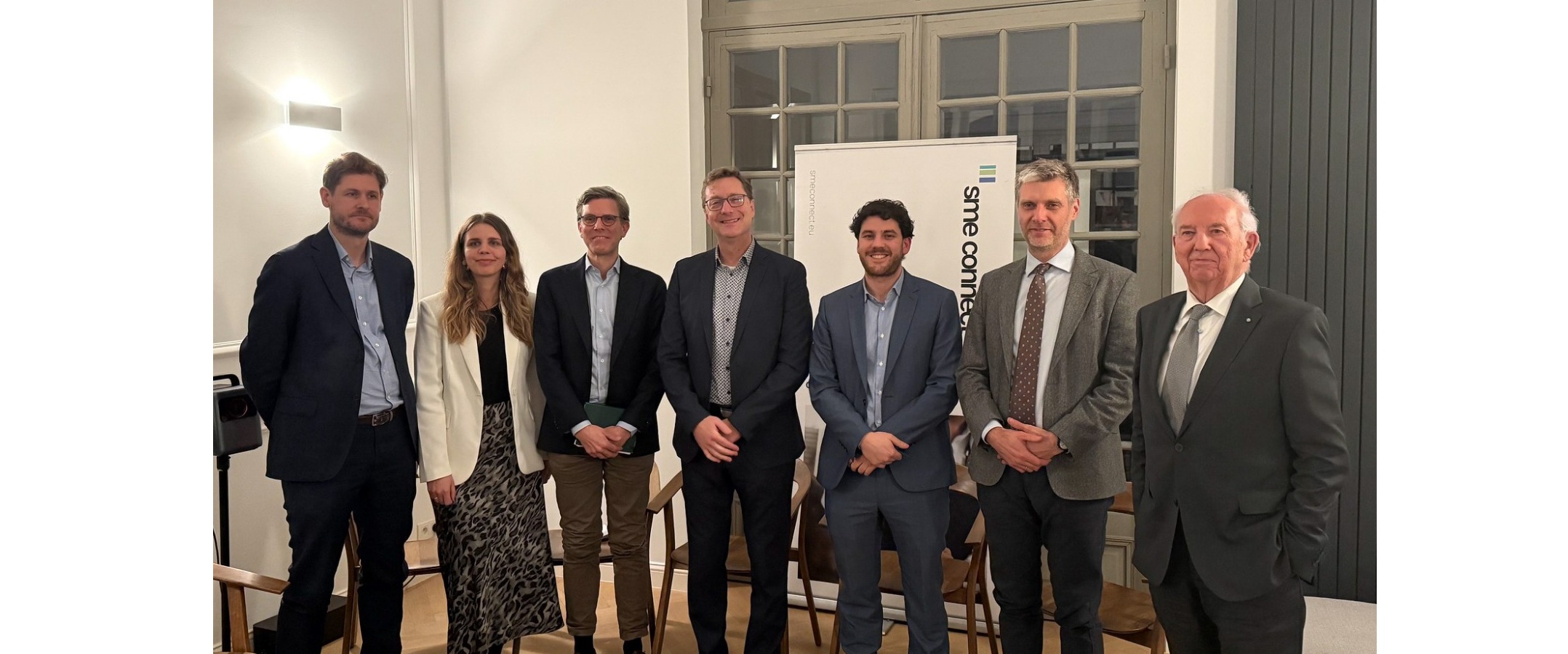
Held at SME Connect’s headquarters in Brussels on 27 January 2026, the panel discussion “The Visibility Crisis: How the Digital Markets Act is Impacting Europe’s SMEs” explored what happens to market access when online visibility is reshaped by regulation and compliance-driven product redesigns. Hosted by Vladimir Prebilič MEP, the session brought together Timothée Giard (Legal Counsel, European Hotel Forum), Emilia Pankiewicz (Senior Policy Officer for Industry Affairs, European Regions Airline Association), Niccolo Ciulli (Advisor for Competitiveness and Commercial Relations, EuroCommerce), Emmanuel Mounier (Secretary General, EU Travel Tech), and Bartłomiej Telejko (Head of the EU Data Governance, Competition and Cybersecurity Policy Team, Google), with moderation by Horst Heitz (Chair of SME Connect’s Steering Committee), challenge narratives and set out what evidence is needed to judge whether the DMA is delivering on its promise of fairer competition.
The discussion focused on how the Digital Markets Act (DMA) is beginning to influence the way online platforms present search and discovery features in sectors such as hospitality, travel and retail. Participants explored what these early changes could mean for SMEs’ ability to reach customers online and which practical indicators can help assess whether implementation is supporting fair competition in real-world user journeys.
In his opening remarks, Vladimir Prebilič MEP presented the DMA as a political choice to limit the power of a small number of gatekeepers, many headquartered outside the EU, and to anchor fair competition, contestability and market access as core European values. He connected this to economic sovereignty and democratic accountability, because the design choices of dominant platforms shape which businesses users discover and where value flows. The DMA, in this view, aims to keep digital markets open so smaller firms compete on the merits of their products and services. He then shifted to implementation, stressing that practical outcomes matter and that policymakers need concrete evidence from business users. He then invited SMEs to share clear examples and data with the Parliament so follow-up work stays grounded in real market effects.
From the hotel sector, Timothée Giard of the European Hotel Forum described a structural challenge in travel distribution, where SMEs face what he called a “double layer” of gatekeeping. Hotels invest significant resources in building and maintaining their own websites and improving their SEO precisely to appear high in Google Search and attract direct, organic bookings. In practice, however, he argued that the space available for organic results is already being squeezed by sponsored placements, and that DMA-driven changes linked to Article 6(5) risk placing intermediary results even higher. The concern is that users may not reach a hotel’s own site without scrolling far down the page, and that direct traffic will increasingly come only through paid ads. If organic reach weakens, hotels may become more dependent on intermediaries such as Booking.com, which typically take a substantial commission on each booking. Reflecting the wider dynamic, he noted: “The way this provision is being interpreted leads to a structural advantage to online platforms rather than direct suppliers’ websites.”
Emilia Pankiewicz from the European Regions Airline Association highlighted similar dynamics in the aviation sector. She argued that airlines are facing the same visibility challenges as hotels, with potential knock-on effects for regional connectivity and ticket prices. According to her, increased reliance on intermediaries translates directly into higher distribution costs, which are ultimately passed on to consumers. She captured this concern succinctly by saying: “You want the consumer to have the choice. But we are not letting the customer having the choice if we are not visible.” She also referred to DMA Article 6(12) as a potentially relevant provision when assessing whether business users are treated fairly in practice.
Niccolo Ciulli of EuroCommerce broadened the discussion to retail and consumer goods, stressing that the problem is exacerbated on mobile devices, where screen space is limited and competition for visibility is intense. He argued that, even before considering any DMA-driven adjustments, the path to an SME’s website is increasingly constrained by what users see first, with AI-generated elements and sponsored results taking up prominent positions and leaving less room for organic links. In that context, he warned that compliance-driven redesigns risk shifting even more attention towards large intermediaries and comparison services, while direct retailer websites are pushed further down the page, forcing users to scroll more to reach them. He also pointed out that many of these intermediated routes are not neutral from a cost perspective, emphasising that Price comparison websites are paid services.
Emmanuel Mounier of EU Travel Tech, which represents intermediaries such as Booking.com, Expedia Group and Airbnb, challenged a narrative that would pit intermediaries against SMEs. He argued that the underlying competition issue remains the power of the main search gateway and the risk of leveraging dominance from general search into vertical services, which is precisely what DMA Article 6(5) is intended to prevent. He used a simple example from the Google Shopping case. At the time, Google placed a dedicated box high on the search results page that steered users towards Google’s own shopping comparison service instead of rival services. His point was that Article 6(5) is meant to stop this kind of self-favouring, not only in shopping but wherever a gatekeeper controls the main entry point to customers. In practice, he argued, everyone is still competing for the same limited space on that results page.
Representing Google, Bartłomiej Telejko explained the company’s view that the DMA’s self-preferencing constraints are leading to a degraded user experience and unintended consequences for both consumers and SMEs. He used Google Maps as a central example, arguing that changes made to avoid favouring Google services can make features less interactive and less useful, which may paradoxically redirect traffic towards intermediaries. He stressed that Google does not generate revenue from direct referrals in the same way as intermediated bookings: “If you book a hotel from Google Maps, the traffic that you are getting is completely for free. We don’t monetise it.” He added that, from Google’s perspective, some compliance-driven changes risk making the search journey less intuitive for users and less predictable for businesses. He also indicated that clearer guidance and more consistent interpretation would help avoid further disruption while the DMA is being rolled out.
In his closing remarks, Vladimir Prebilič MEP underlined that the DMA is a political choice aimed at protecting fair competition and keeping markets open, but that the decisive test is whether it works in practice for SMEs and consumers. He encouraged participants to translate concerns into concrete, verifiable examples, and stressed that implementation is not static and can be corrected through dialogue and evidence, including via engagement with the Parliament and the Commission, and he signalled openness to continued contact so that the issues raised can be followed up through the relevant institutional channels.
The discussion closed on a constructive, if critical, note. The DMA’s objective is widely shared, but its impact will depend on how rules translate into real interfaces and business outcomes. Several speakers argued that this is precisely where better regulation should apply, with policymakers, regulators and platforms using clear evidence to adjust guidance and enforcement so that compliance does not add unnecessary complexity or costs for smaller firms. In particular, the aim should be to avoid a situation where de facto “double monopolies” in the user journey become even more entrenched and drift towards a single dominant route to customers. If the next steps focus on practical fixes, simple and predictable implementation, and ongoing monitoring of effects on SMEs and consumers, the DMA can still become a framework that improves fairness while making SMEs and consumers stronger in this market environment.